11:00 am – 12:30 pm
Opening
Creative Land Acknowledgement and Welcome Note by Qissa.
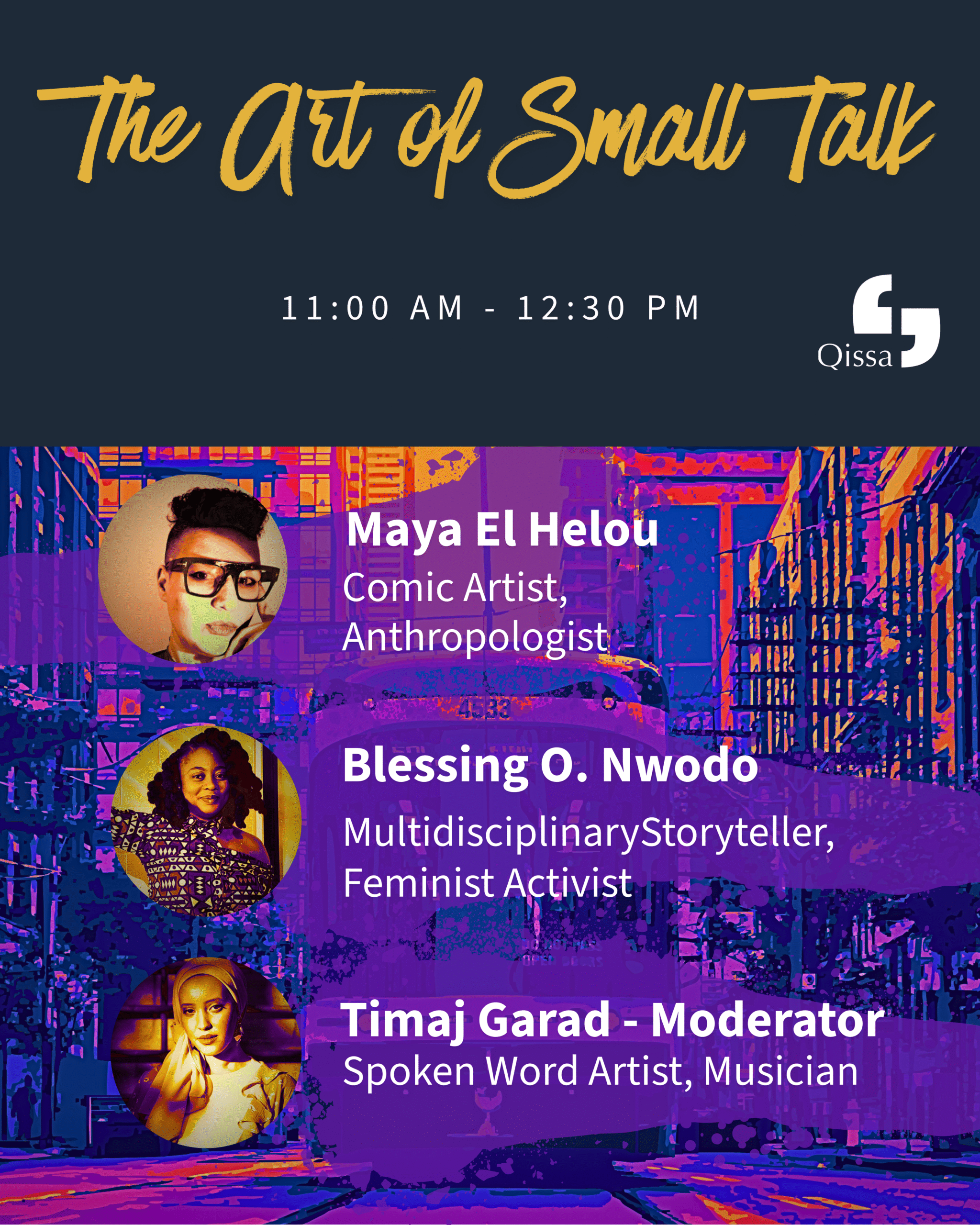
The Art of Small Talk: “What Do You Do?”
The session opens with a performance based on the work of Maya El Helou, a comic artist and anthropologist, drawn from her literary work on Small Talk. Through a presentation and a live reading, this performance dissects the rituals of small talk, including the comic challenge of responding to What do you do? when the answer is: I study death.
The presentation flows into a theatrical performance based on Blessing O. Nwodo’s Time to Earn a Living. Through her work, Blessing interrogates the absurdity of the phrase “earning a living,” questioning a system that demands proof of worth for the very act of being alive, and insisting instead on our inherent right not just to survive, but to live well. The performances will be followed by a panel discussion.
Featuring
Maya El Helou: Comic Artist, Anthropologist
Blessing O. Nwodo: Multidisciplinary Storyteller, Feminist Activist
Panel Sponsor: The Carol Shields Prize Foundation
About the Writers:
Maya El Helou holds a PhD in Anthropology and Sexual Diversity Studies. Their research reflects on what it means to conduct scholarship that resists extraction while remaining entangled in academic structures that demand it. El Helou’s work focuses on violence and necropolitics in the Middle East, with particular attention to urban Beirut. They work with graphic ethnography as a method, combining visual storytelling with ethnographic theory to explore practices of resistance and survival. Maya is also a published comic artist whose work critically engages settler colonialism, patriarchy, and intersecting systems of oppression through a queer feminist lens. They are also a lecturer in anthropology, gender, and sexuality studies.
Blessing O. Nwodo is a Toronto-based, multidisciplinary storyteller. Her work spans a diverse range of mediums, including opera, immersive art exhibitions, film, sonic storytelling, and published fiction, poetry, and nonfiction. A graduate of the Iowa Writers’ Workshop, she also holds an MFA from the University of Guelph, and has served as Editor of Held Magazine. An alumna of the University of Nigeria, she was honored as Best Female Writer in 2017. Her stories have won the 2016 Nigerian Travel Story, been shortlisted for the 2021 Toyin Fálọlá Prize, the 2021 African Writers Awards, the 2018 Igby Prize for Nonfiction, and the 2019 Lost Balloon Pushcart Prize. When she’s not relishing fashion, she can often be found pulverizing the patriarchy. She is working on a collection of speculative fiction, and a novel.
Timaj Garad (Moderator) is an Ethiopian-Harari Toronto-based multi-disciplinary storyteller, Arts Educator, and Community Organizer who uses poetry, theatre, and music to bring her stories to life. Her art is autobiographical, working at the intersections of a Black Muslim woman challenging injustice, unearthing truths, and healing. As an award-winning artist & arts educator, Timaj has graced over 400 stages and facilitated several arts-based workshops around the world. Timaj is the Founder of LUMINOUS Fest – Canada’s first Black Muslim arts festival, and Co-founder of The Sisters’ Retreat – a retreat series hosting local and international arts-based wellness retreats for Muslim Women. She currently lives in Toronto, sharing her poetry and music on stages across the province, continuing to organize arts events, and working on new music. She released her single and music video “Black Gold” as well as her debut EP ‘Blooming at the Mouth’. Timaj is currently working on her second EP. With rich lyrical landscapes, soulful vocals, and a unique blend of singing and spoken word poetry, ‘Blooming at the Mouth’ offers listeners intimate, thought-provoking storytelling coupled with anthemic, lively hooks carrying undertones of hope. Timaj believes in the transformative power of the arts to build capacity and strengthen communities.

12:30 pm – 1:30 pm
Lunch Break | Meet the Artists | Driving Canada Exhibit
The lunch break offers an opportunity to meet featured artists, browse the bookstore, and experience Qissa’s Driving Canada exhibition.
The exhibition is based on Driving Canada project, a collaboration between Qissa and the Canadian Museum of Immigration at Pier 21 that video-recorded oral histories of immigrants and refugees in Toronto who currently drive or have driven for ride-share apps in the past.
This is the first public exhibition of the project.
Exhibition Sponsor: World Education Services
Lunch & Dinner by Newcomer Kitchen
Festival attendees can also pre-order hot lunch and dinner prepared by newcomer chefs through Newcomer Kitchen, a Toronto-based social enterprise supporting newcomer women entrepreneurs. Meals must be ordered in advance and will not be available for purchase on site.

1:30 pm – 2:45 pm
Mirror, Mirror: Disappearance and the Migrant Body
This multidisciplinary performance by Tala Motazedi unfolds through narration, contemporary dance, sound, and projected archival imagery. Centered around a mirror on stage, the piece begins with a century-old family story and moves to the present, tracing the disappearance of a father, and ultimately, the disappearance of the self through migration. The performance is followed by a dramatic reading of writer Mostafa Al-A’sar’s piece, Never Forget What You Are that explores migration as a series of “smaller deaths.” Together, Mostafa and Tala examine disappearance as a condition of migration, followed by a panel conversation with the writers.
Featuring
Tala Motazedi: Screenwriter, Playwright, Novelist
Mostafa Al-A’sar: Journalist, Human Rights Defender, Author
About the Writers:
Tala Motazedi is an Iranian filmmaker, screenwriter, and playwright based in Canada. After years of professional work in Iran, she was forced to leave the country due to censorship and political pressure and now continues her artistic practice in exile. Her work centers on women’s experiences, queer identity, the body, repression, and life under authoritarian systems. She often blends social realism with symbolic or supernatural elements to explore how power, silence, and fear shape both private and collective lives. In recent years, her storytelling has increasingly focused on migration, exile, and the reconstruction of identity after long periods of enforced invisibility. Tala Motazedi is a recipient of the PEN Canada–Humber College Writers in Exile Scholarship. Her work has been presented at international festivals and platforms. She is currently based in Toronto, where she is developing film and documentary projects that examine freedom, memory, resistance, and the enduring impact of displacement on the body and imagination.
Mostafa Al-A’sar is an award-winning Egyptian journalist, researcher and human rights defender. Al-A’sar endured four years in detention in Egypt as a prisoner of conscience for his journalism before fleeing to Lebanon and later relocating to Toronto, Canada. He is a 2025 Journalists for Human Rights contributing writer for The Walrus and was a 2024/2025 Canadian Journalists for Free Expression/Massey College journalism fellow at the University of Toronto. He founded REDWORD for Human Right and Freedom of Expression, a Canadian nonprofit dedicated to defending free expression and countering misinformation, fake news and hate speech.
Andrea Gunraj (Moderator) is an essayist, fiction writer, public speaker, and thought-leader. She writes about hidden stories of equity-seeking people and their convergence across lines and boundaries. Her forthcoming nonfiction book, Go-Between Girl: My Indentured Past as Reclaimed Present, will be released by McClelland & Stewart in 2026. She is author of the ReLit shortlisted The Lost Sister (Vagrant Press, 2019) and critically acclaimed The Sudden Disappearance of Seetha (Knopf Canada, 2009). Her short fiction has been published in The Ex-Puritan and FreeFall Magazine and has been longlisted for the CBC Short Story Prize. Her non-fiction includes an essay in Subdivided: Building Inclusion Into the Global City (Coach House Books, 2016) and articles in WIRED, Spacing Magazine, and The Philanthropist Journal.
3:00 pm – 4:15 pm
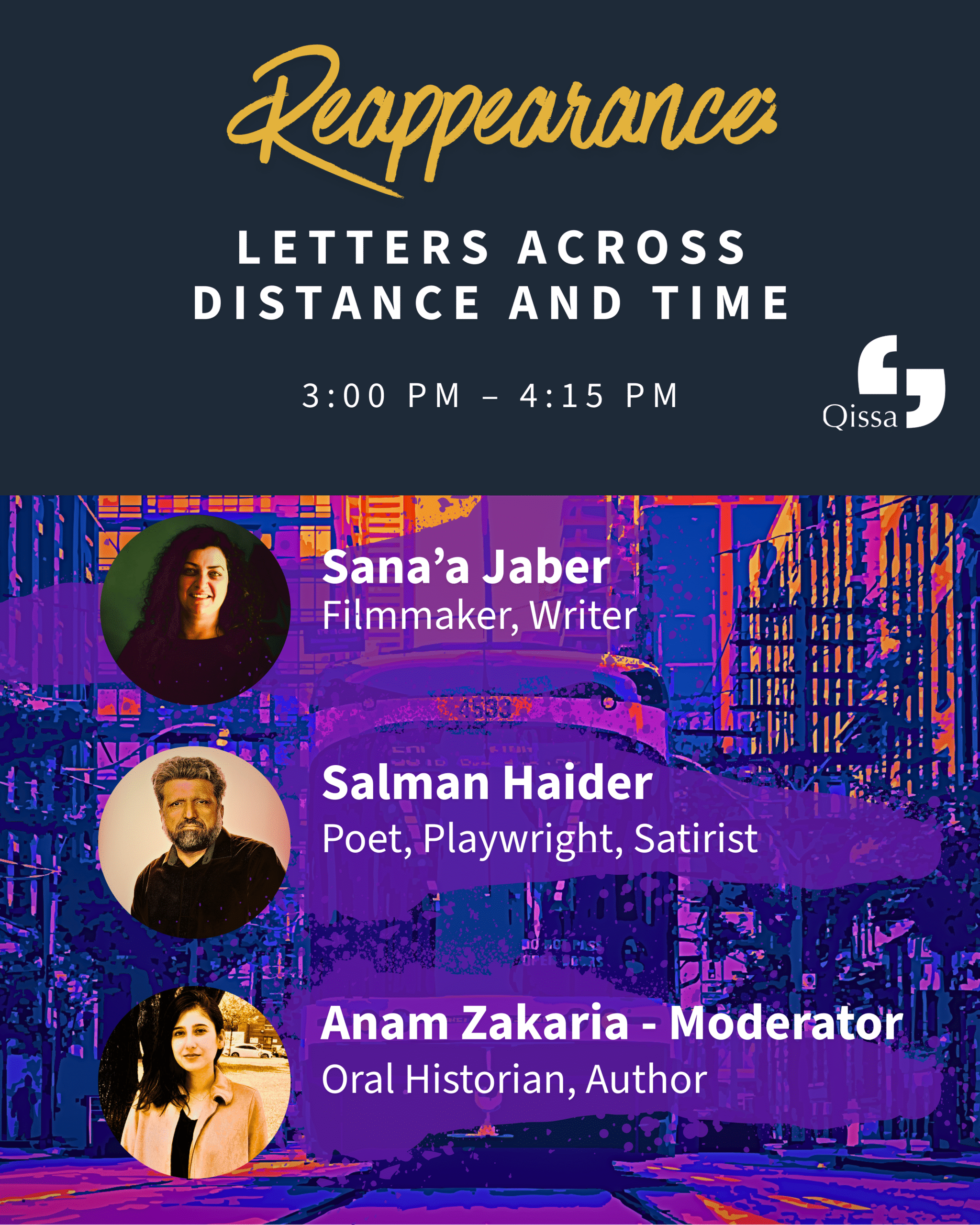
Reappearance: Letters Across Distance and Time
This session opens with a reading by Sana’a Jaber from A Letter to Baba, an intimate reflection on time, distance, and the small details that measure separation. Accompanied by live music, the piece reflects on the quiet transformations that unfold across years of separation. It is followed by a performance by Salman Haider, whose poem After Eight Years traces the fragile encounter of reunion. Through poetry and music, the piece reflects on reconnection after years of separation. The session concludes with a panel conversation.
Featuring
Sana’a Jaber: Filmmaker, Writer
Salman Haider: Poet, Playwright, Satirist
About the Writers:
Sana’a Jaber is a Lebanese writer, mother, filmmaker, and refugee based in Toronto. She weaves stories of exile, resilience, motherhood, and belonging, drawing from a life lived across cultures and borders. Her short story won the prestigious Carol Shields Prize in Canada, and her work spans fiction, memoir, and storytelling for social change. Before settling in Toronto, Sana’a spent over two decades working in film and television as a writer, art director, and sound recordist. Through her writing, she gives voice to those often unheard—refugees, women, dreamers building new homes in unfamiliar lands. Sana’a is currently completing her first book.
Salman Haider is a poet, playwright, and satirist in exile, with performances and publications in Pakistan, the U.S., and Canada. Detained and tortured for his outspoken work, he continues to use satire and poetry as acts of resistance and survival. He holds a PhD in Psychology.
Anam Zakaria (Moderator) is a writer, oral historian, and the Co-Founder and Strategic Director of Qissa. She is the author of 1971: A People’s History from Bangladesh, Pakistan and India, Between the Great Divide: A Journey into Pakistan-administered Kashmir, and The Footprints of Partition, which won the 2017 KLF–German Peace Prize. Her work explores memory, migration, and the politics of remembering and forgetting, and has appeared in publications including The Walrus, CBC, Toronto Star, Al Jazeera, and Dawn. Anam has over a decade of leadership experience in the non-profit sector across South Asia and Canada and is currently based in Toronto.

4:30 pm – 5:30 pm
Empire, Movement, and Food
This session opens with An Evening in the Government House, a two-character drama set in 1906 and written by author, Harleen Singh. Over the course of a winter evening, Mary Minto, the Vicereine of India, and her Sikh ayah, Harnam Kaur, speak of children, memory, and distant lands — including Canada. Through their conversation, the play contrasts two very different experiences of imperial movement. The performance is followed by a panel discussion on the legacies of empire and migration, and concludes with a participatory presentation by Ahmer Naqvi. Through a shared tasting experience, he reflects on assimilation, commodification, and the lingering presence of colonial histories in everyday life.
Featuring
Harleen Singh: Writer, Researcher, Archivist
Ahmer Naqvi: Writer, Broadcaster
Panel Supporter:
Toronto International Festival of Authors
About the Writers:
Harleen Singh is a writer and researcher focusing on the social and literary history of colonial Punjab and the North West Frontier Province (now Khyber Pakhtunkhwa in Pakistan). Born and raised in Delhi, Harleen’s interest in history was sparked by the Partition experiences of his grandparents, whose stories he heard growing up. These personal histories sparked his interest in oral history as a means of preserving these narratives. In 2014, Harleen began documenting the stories of Partition survivors, which led to the creation of The Lost Heer Project in 2018, dedicated to uncovering the largely forgotten narratives of women in colonial Punjab. Based in Toronto, Harleen is currently researching the historical relationship between the twin cities of Lahore and Amritsar.
Ahmer Naqvi is a writer whose work explores popular culture as a lens for understanding society, power, and everyday life. His writings have primarily focused on food, cricket and music, and he’s been published in Fifty Two, Caravan, Dawn, ESPNCricinfo amongst others. He has also worked as the digital head of the PSL cricket league, COO of Pakistani music platform Patari, and founded Khanay Mei Kya Hai, food tours of Karachi which showcase indigenous cuisines.
Aparita Bhandari (Moderator) is an arts and life reporter in Toronto. She has been published in Canadian media including CBC, the Toronto Star, The Globe and Mail and Walrus magazine. Her areas of interest and expertise lie in the intersections of gender, culture and ethnicity. She is the producer and co-host of the Hindi language podcast, KhabardaarPodcast.com.
Food Notice: This session includes a small tasting experience. The food contains DAIRY, CHICKEN, TOMATOES, and SPICES. If you have any allergies or sensitivities, we strongly advise that you do not consume the food. The tasting includes a NON-HALAL chicken dish and either a HALAL chicken or vegetarian option, depending on your selection.

5:30 pm – 6:00 pm
Keynote: Randell Adjei
Randell Adjei is an Author, Inspirational Speaker, Arts Educator and Community Leader who uses the spoken word to empower and transform through Edutainment. He is the founder of one of Toronto’s largest and longest running youth led initiatives; Reaching Intelligent Souls Everywhere (R.I.S.E Edutainment).
He is Ontario’s first Poet Laureate (2021).
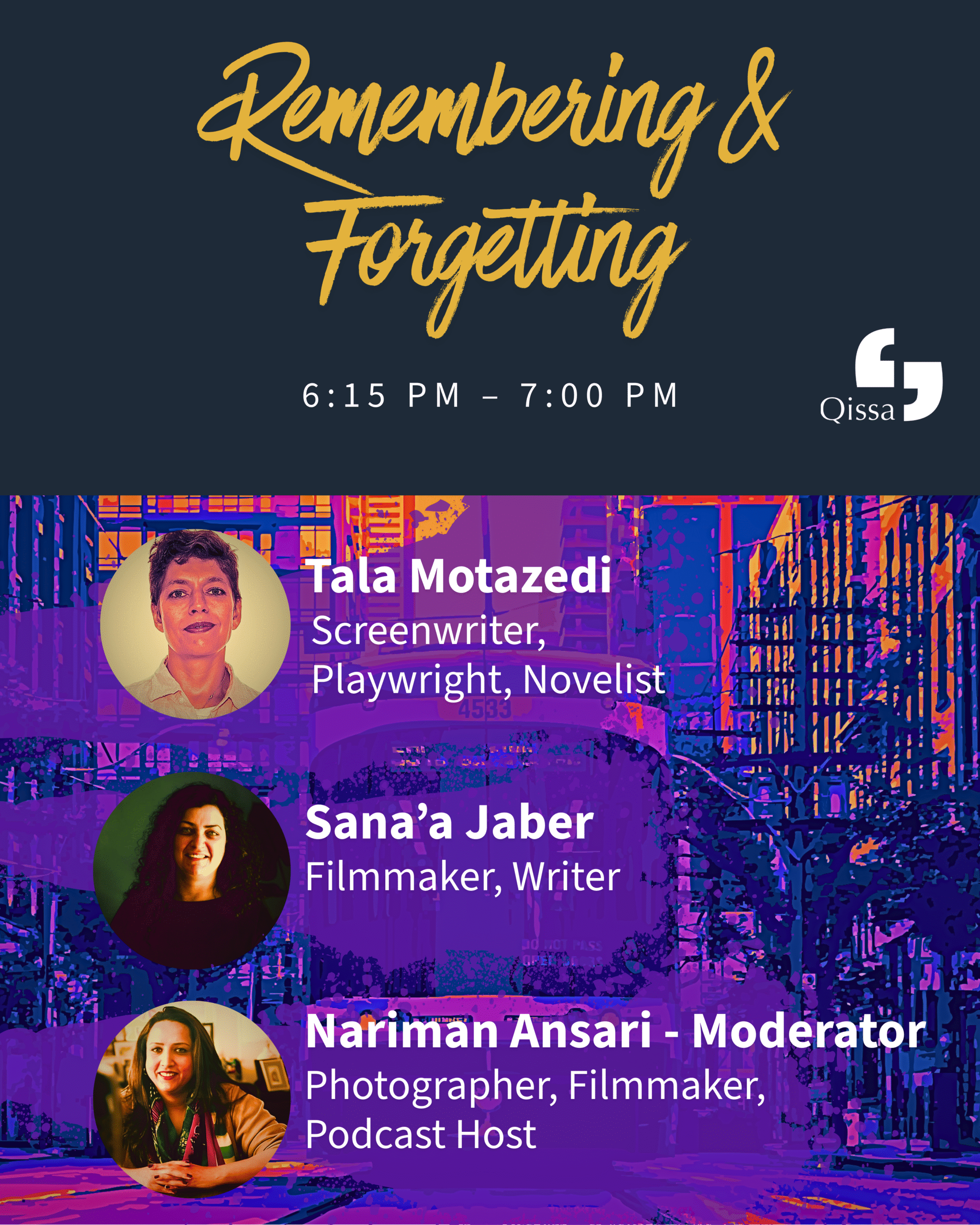
6:15 pm – 7:00 pm
Remembering & Forgetting
Screening by Tala Motazedi and Sana’a Jaber. Through image, voice, and sound, the films reflect on memory, displacement, and the shifting relationship to language and self that migration can produce. The screenings are followed by a conversation with the artists and an audience Q&A.
Nariman Ansari (Moderator) is a photographer, filmmaker, and storyteller whose work explores identity, representation, and the power of narrative. She began her career in television before establishing one of Karachi’s first female-led portrait studios in 2008. Her photography and film projects—often focused on South Asian women, cultural memory, and challenging stereotypes—have been exhibited internationally across Asia, Europe, and North America. Now based in Canada, Nariman continues to amplify South Asian voices across mediums and is the host of the video podcast BeyGhum Begums, a platform for intimate conversations about women’s power, freedom, and self-definition.

7:00 pm – 8:00 pm
Musical Evening
The festival concludes with a live musical performance featuring Gandhaar Amin and Dhaivat Jani. Blending classical training with contemporary interpretation, their work moves across traditions, languages, and diasporic soundscapes. Rooted in migration, memory, and musical lineage, the evening offers a celebratory and reflective close to the day’s conversations.
About the Performers:
Gandhaar Amin is a Bansuri Player trained in the Hindustani classical tradition whose work bridges classical form and contemporary expression. His performances draw on rich musical lineages while engaging new audiences across cultural contexts.
Dhaivat Jani is a drummer, tabla player and composer whose practice spans classical performance and collaborative projects across genres. His work brings rhythmic depth and improvisational energy to stages in Canada and beyond.
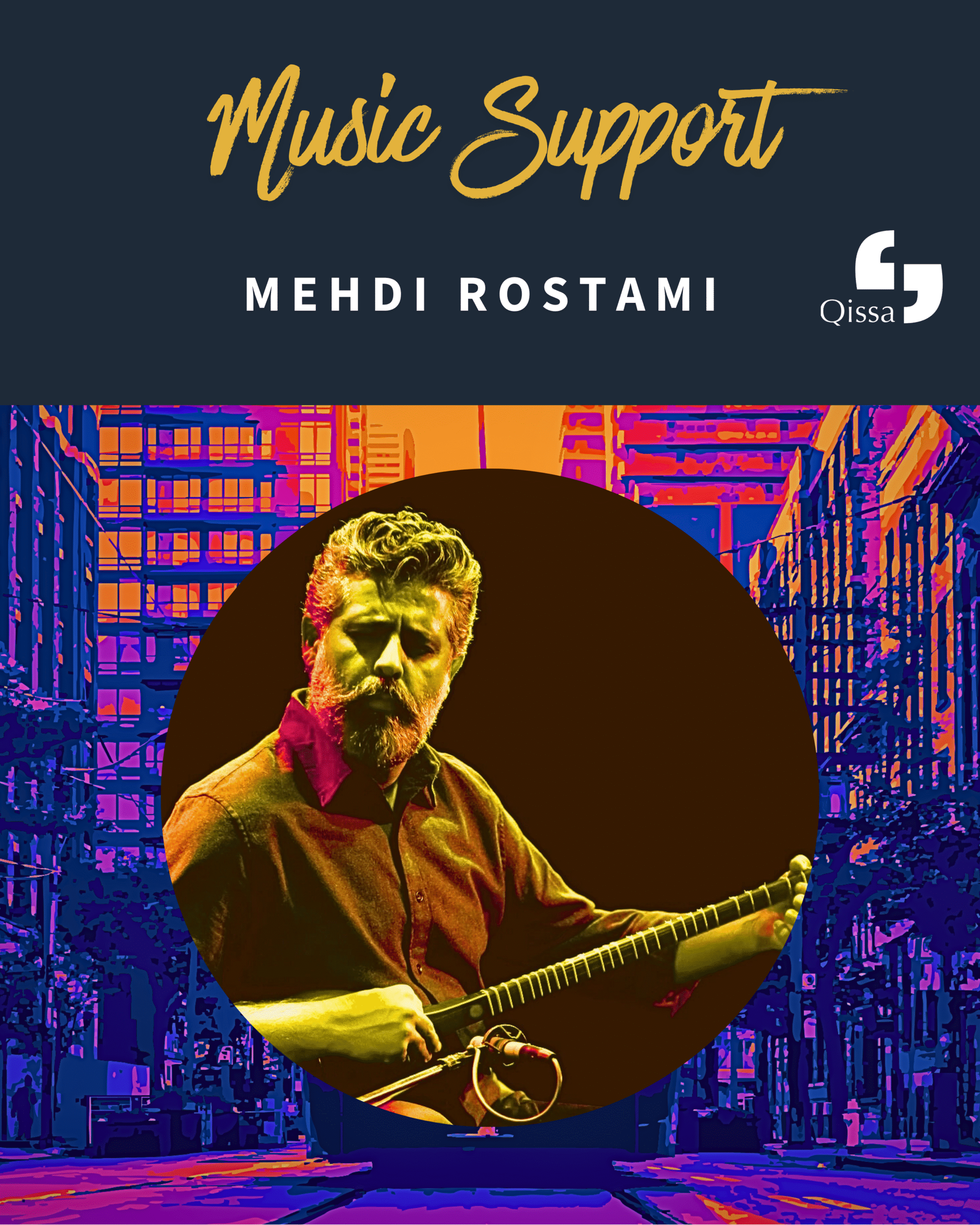
Live Music During Performances
Live music throughout the festival’s performances is provided by Mehdi Rostami, whose setar accompaniment adds an atmospheric layer to several artistic presentations across the day.
About the Performer:
Mehdi Rostami is an Iranian musician, composer, and Setar player based in Toronto. His work explores the spirit of Persian improvisation and the meeting point between Iranian classical music and contemporary world sounds. Through performance and collaboration, he brings the intimate voice of the Setar to diverse audiences.
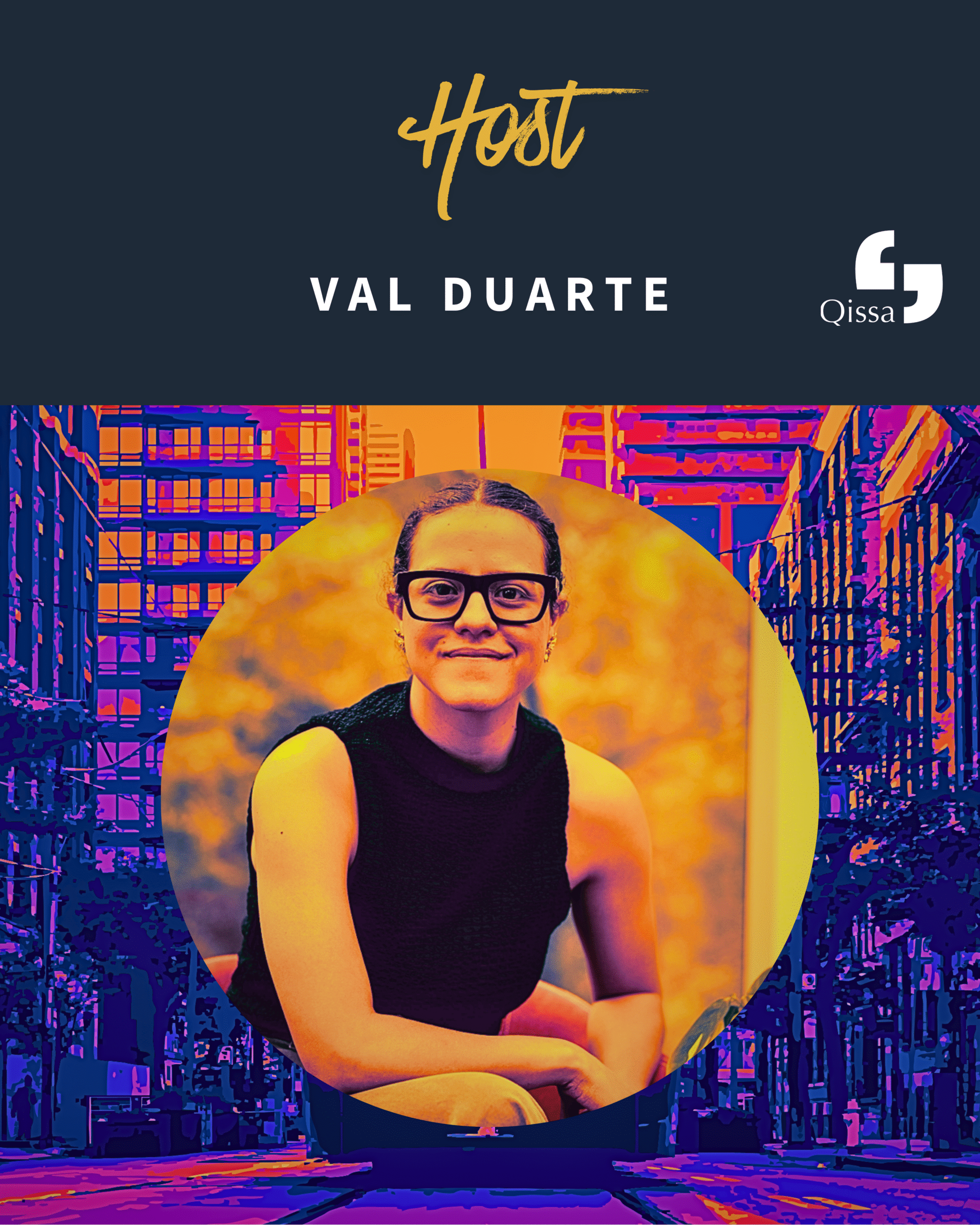
Host
Val Duarte will host the festival, guiding audiences through the day’s program while weaving in reflections from her own journey as a newcomer.
About Val:
Val Duarte is an interdisciplinary artist and researcher working in socially engaged and participatory art. Her practice centers on designing tools, gatherings, and collaborative spaces where artists can explore authorship, creative labour, and the conditions that shape their ability to sustain a practice. She is the lead author of Creating with Nature, a creative card deck that invites people to reconnect with the natural world as a source of inspiration and reflection. Val co-led the project Reframing Creativity with David Gauntlett at Toronto Metropolitan University, exploring how independent artists and creators navigated identity, disruption, and creative practice during the COVID-19 crisis. She also contributed to the creation of the KUNE Music Hub study on the experiences of immigrant musicians in Toronto and co-led the second cohort of Project CREA, a mentorship program for Latin American youth artists through Creato. She currently works with the Future Skills Centre, exploring the future of work and asking how we can build careers and ways of working that feel human, creative, and sustainable in a rapidly changing world—her medium, ultimately, is the space between people.
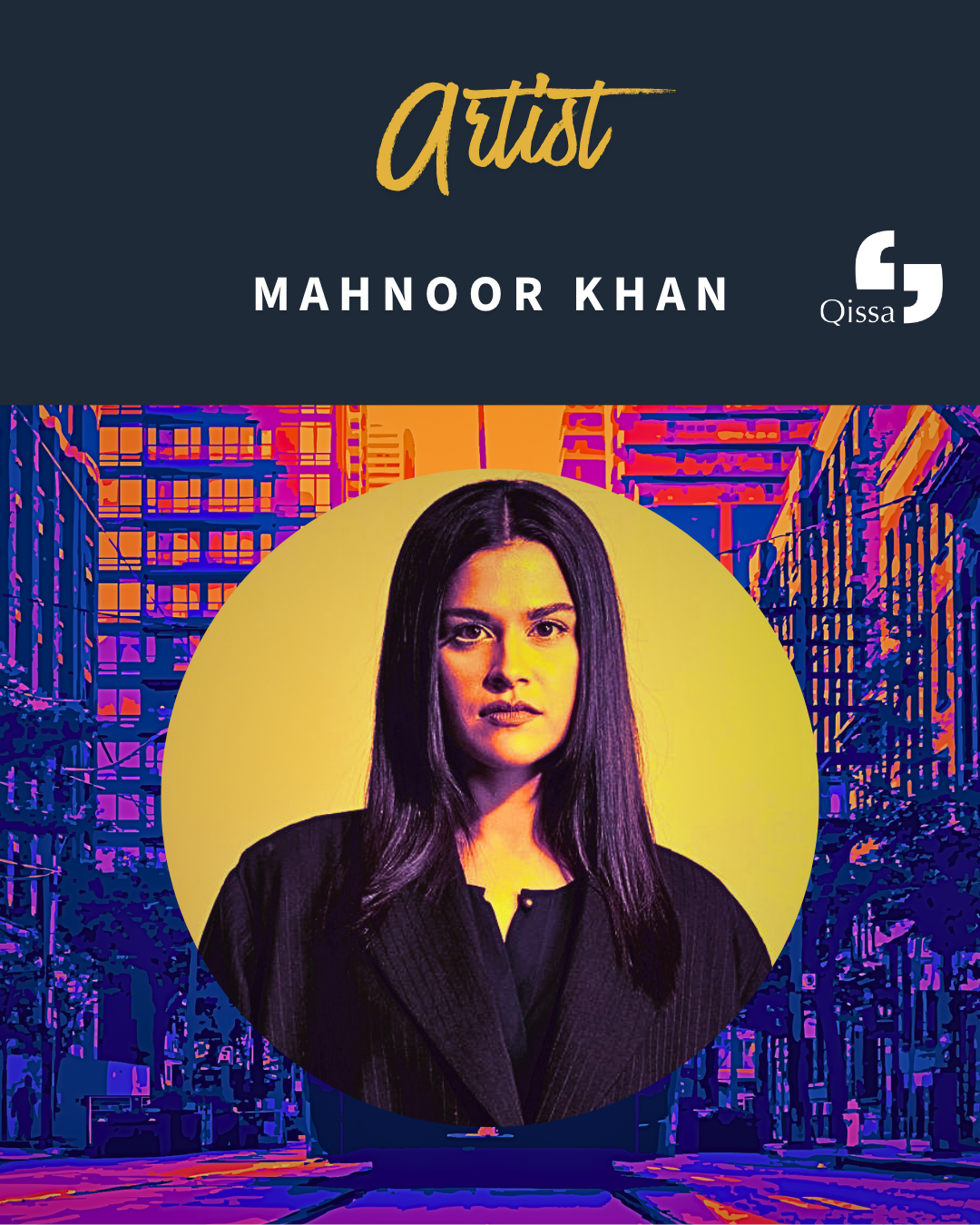
Mahnoor Khan will be the performing the character of Ogechukwu in Blessing O. Nwodo’s play, Time to Earn a Living. This short performance will be featured in the session, The Art of Small Talk: “What Do You Do?”
About Mahnoor:
Mahnoor Khan is a Pakistani-Canadian actor and producer whose work moves fluidly between the theatre stage and the silver screen. She is also the co-founder of Virasat TO, a Toronto-based artist collective grounded in South Asian artistic practices and committed to creating space for connection, collaboration, and the celebration of heritage through art. Across her creative practice, Mahnoor is driven by a strong commitment to representation, artistic integrity, and stories that honor the richness, nuance, and complexity of our lived experiences.
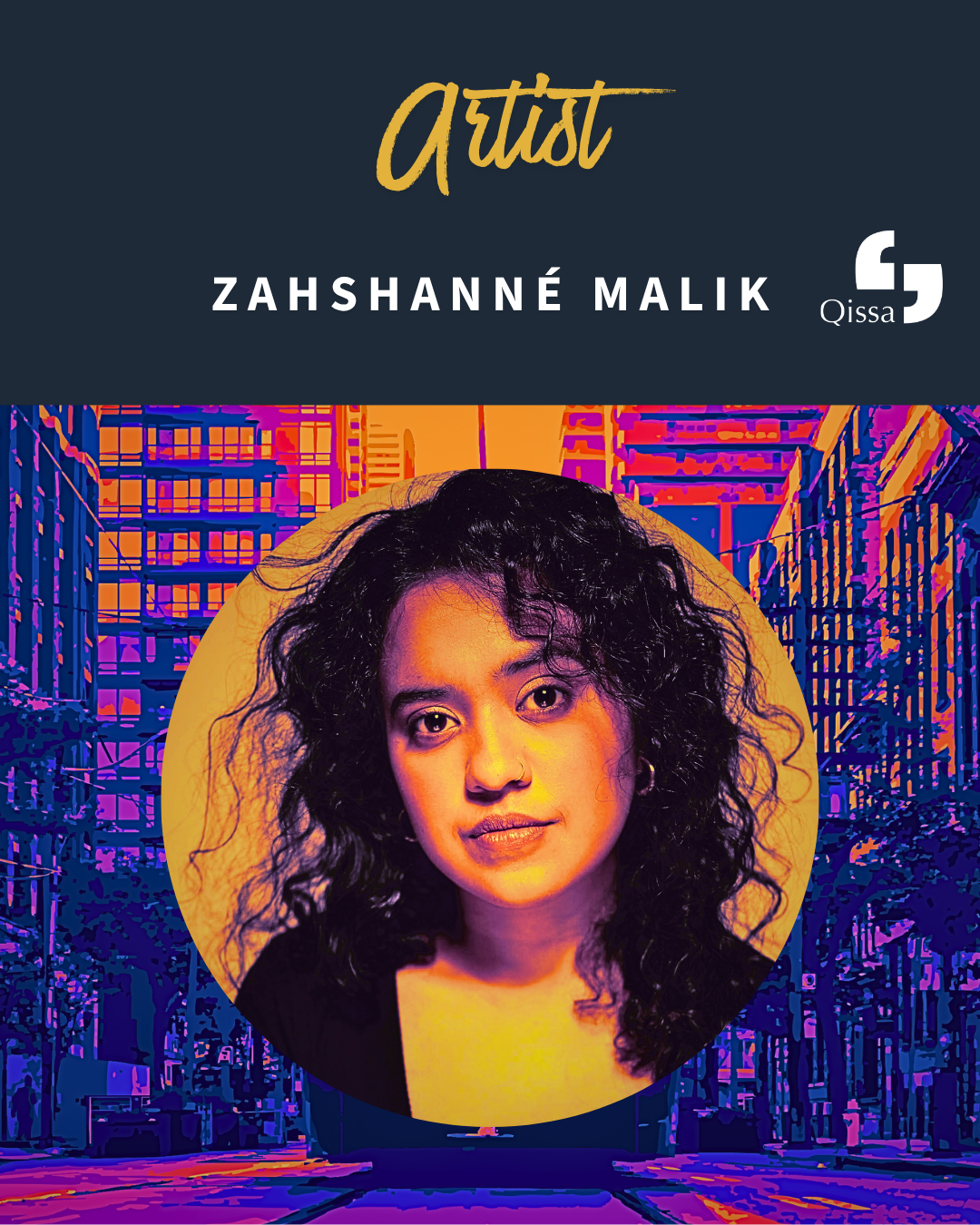
Zahshanné Malik will be performing a contemporary dance to accompany Tala Motazedi’s multidisciplinary presentation titled Mirror, Mirror, featured in the session, Mirror, Mirror: Disappearance and the Migrant Body.
She will also be playing the character of Harnam Kaur in Harleen Singh’s play, An Evening at the Viceregal Lodge, in the session, Empire, Movement, and Food.
About Zahshanné:
Zahshanné Malik is a performer and theatre-maker whose work lives at the intersection of movement and storytelling. Trained in Kathak, with extensive international performance experience, she is excited to perform for Canadian audiences and collaborate with artists from around the world. Most recently, she appeared as Sita in New by Pamela Sinha and will also be performing in this year’s Toronto Fringe Festival. She is honoured to be part of Qissa’s Newcomer & Refugee Festival, sharing stories through both theatre and dance.
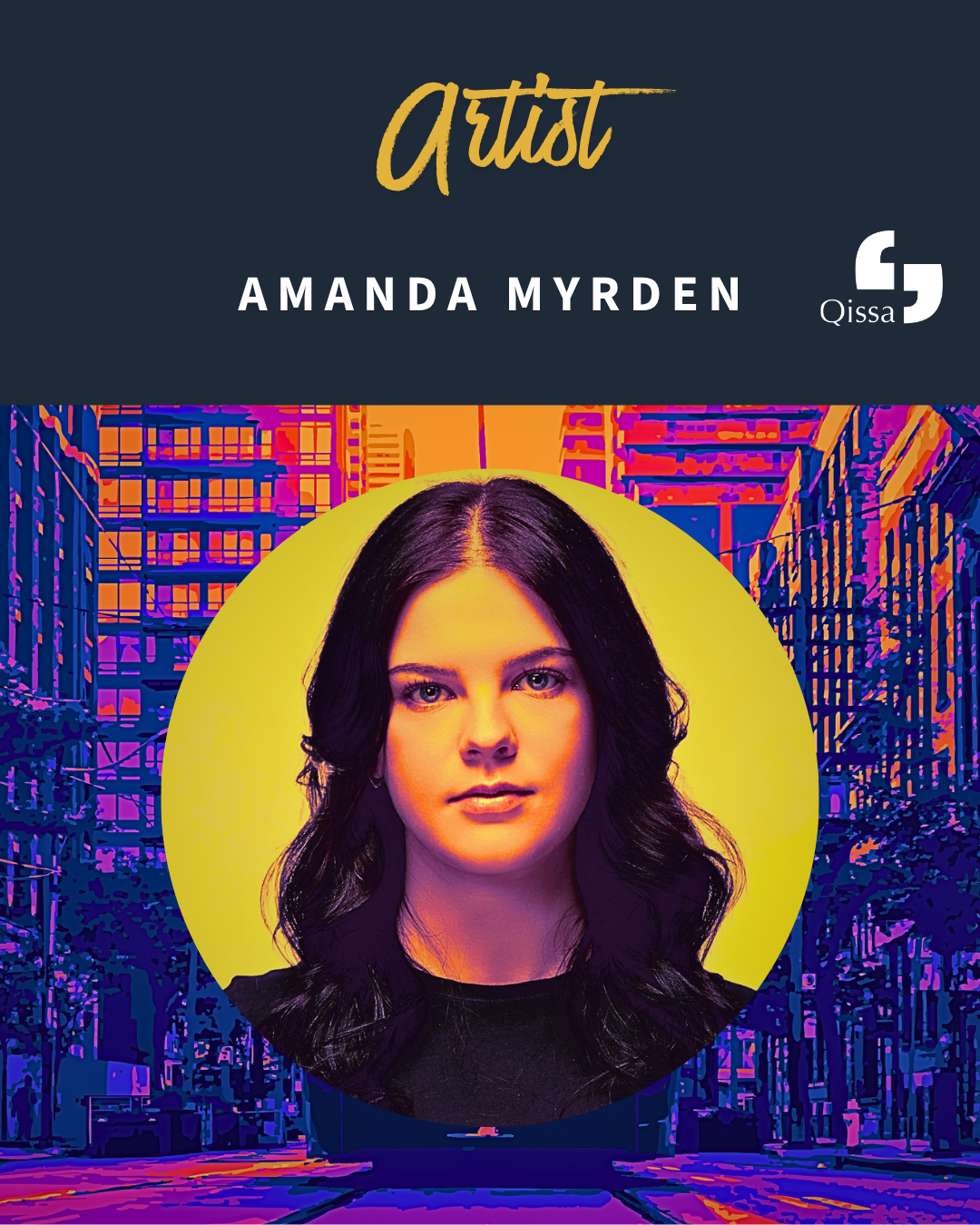
Amanda Myrden will be playing the character of Lady Minto in Harleen Singh’s play, An Evening at the Viceregal Lodge, in the session, Empire, Movement, and Food.
About Amanda:
Amanda Myrden is a Canadian performer with a passion for storytelling and the performing arts. She is a graduate of the Theatre Arts and Performance program at Centennial College, where she trained under industry professionals and developed her skills in acting, dance, and vocal performance. With a background in multiple dance styles and vocal techniques, Amanda has also received awards in regional musical theatre competitions. She brings versatility, dedication, and heart to every role and is excited to be part of this production.
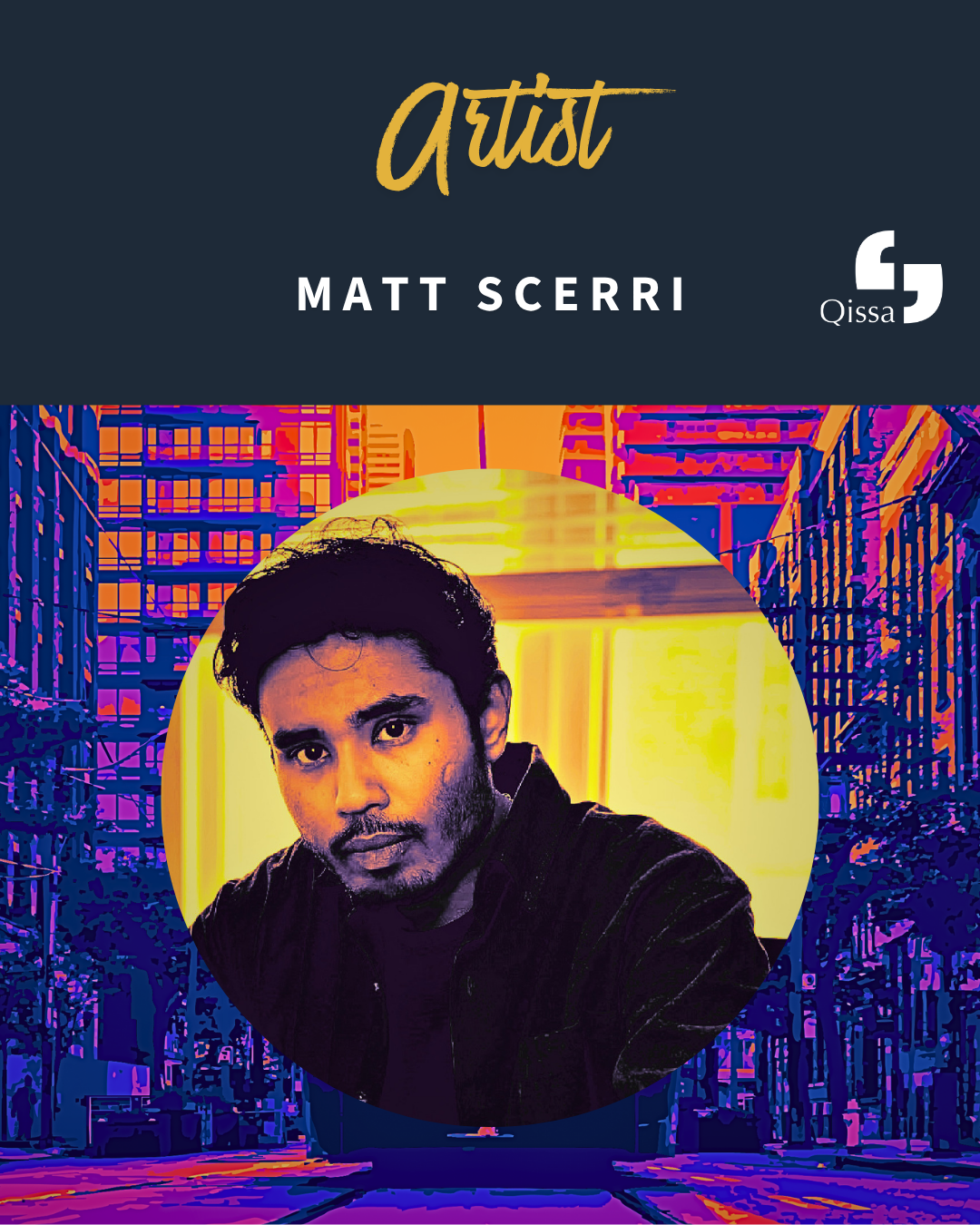
Matt Scerri will be performing the piece Never Forget What You Are, by Mostafa Al-A’sar, featured in the panel, Mirror, Mirror: Disappearance and the Migrant Body.
About Matt
Actor from Toronto, ON. Graduate of The Second City, William Esper Studio, and HB Studio in NYC – Matt has performed across Toronto with Alumnae Theatre, Crows Theatre, and Helen Gardiner P. Playhouse, as well as multiple short films that have premiered in festivals across Toronto, Vancouver, Italy, and France. Matt finished a run for the 2025 Toronto Fringe Festival, where his performance in Silence, garnered reviews from multiple platforms, most notably, Toronto Star – Matt is enlightened to be representing the fierce voices of the Qissa Festival, and he is also returning to the Helen G. Phelen Playhouse for a Suzan Lori-Parks production titled 365 Days/365 Plays in April 2026 – Matt would like to thank his many heroes in performance, who inspires his work to continue pursuing the truth.
This festival is recommended for audiences 16 years and older.