For Toronto International Festival of Authors 2026, Qissa is curating four sessions exploring language, labour, oral history, and the ways immigrant identities are translated, packaged, and understood. Bringing together writers, artists, journalists, researchers, and community practitioners, the series examines the structures that shape creative work, representation, and belonging in Canada.
Writing Outside English and French: Language, Audience, and Recognition in Canada
Sat, Oct 31, 11:30 am to 12:30 pm
Northrop Frye Hall, Room 003
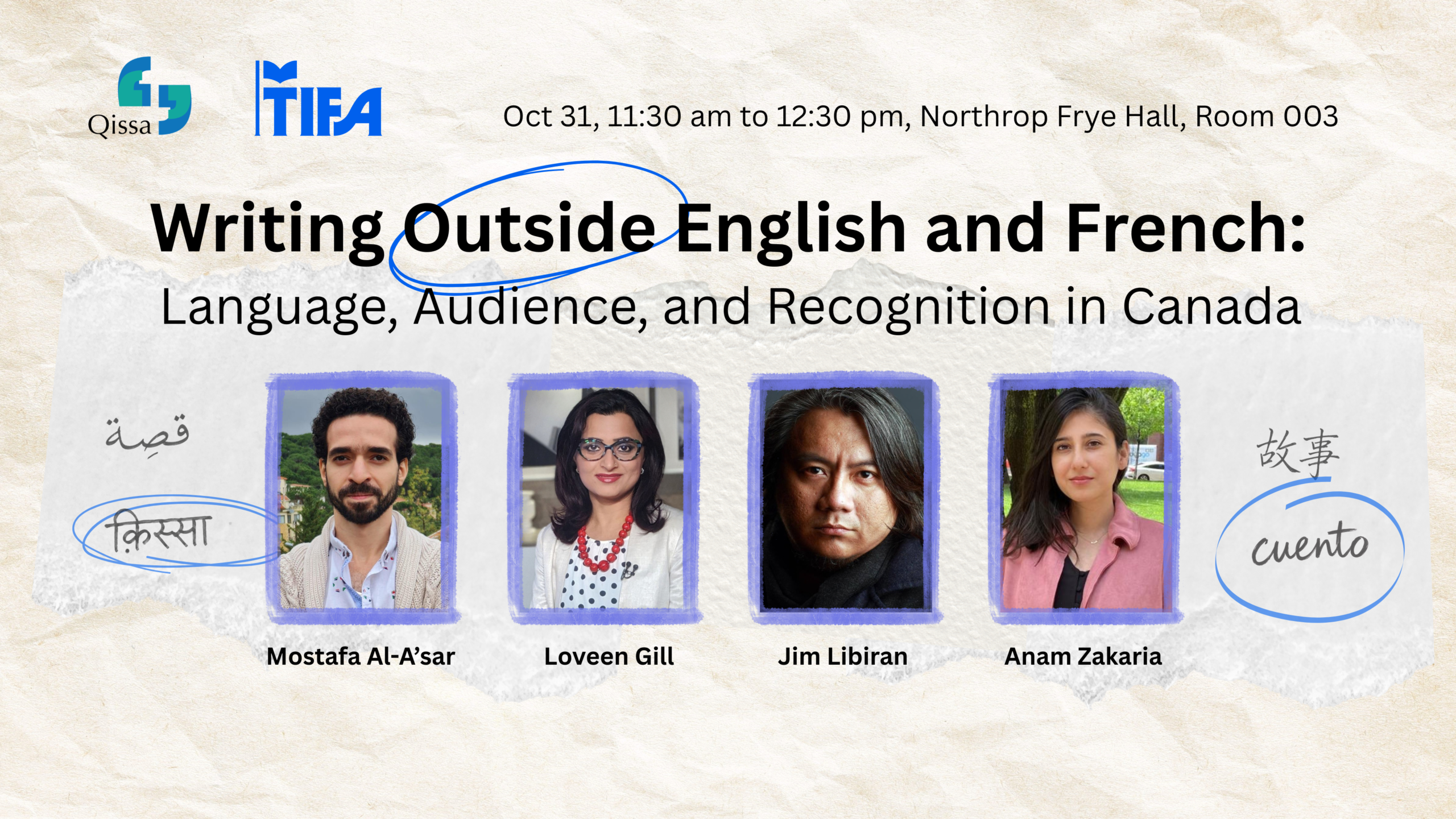
This session explores what it means to write in a language other than English or French in Canada, where most literary opportunities, resources, and audiences are concentrated in the country’s two official languages. How do newcomer and refugee writers writing in languages other than the two official languages, continue to develop their practice and reach readers? Do they feel pressure to transition into English or French? The conversation considers how writing in a new linguistic and cultural context may shape a writer’s subjects, style, and relationship with their audience, as well as what can be lost, gained, or transformed through translation. It also asks how Canada’s literary institutions might better recognize and support writing produced beyond English and French.
Featuring:
Mostafa Al-A’sar: an award-winning Egyptian journalist, human rights defender, and founder of REDWORD for Human Rights & Freedom of Expression, currently based in Toronto.
Loveen Gill: a host and reporter at OMNI Television whose journalism focuses on community-centred stories, including domestic violence, international students, and South Asian seniors. They are also the founder of Amar Karma Health & Wellness Awareness Network, Canada’s first South Asian nonprofit promoting organ and tissue donation, and have led awareness initiatives across Canada and India.
Jim Libiran: a Filipino filmmaker, writer, poet, journalist, and social entrepreneur whose work blends socio-political themes with community-based storytelling. His films have earned 15 international and local awards, and his career spans conflict reporting, grassroots organizing, print journalism, and television.
Anam Zakaria (Moderator): writer, oral historian, and Co-Founder and Strategic Director of Qissa, Anam’s work explores state narratives, intergenerational memory, and the politics of remembering and forgetting. She is the author of three books, including The Footprints of Partition, which won the 2017 KLF-German Peace Prize. She is currently based in Toronto where she documents oral histories of immigrants to Canada.
Who Gets to Tell the Story? Oral History Againt Erasure
Sat, Oct 31, 1:00 pm to 2:00 pm
Northrop Frye Hall, Room 003
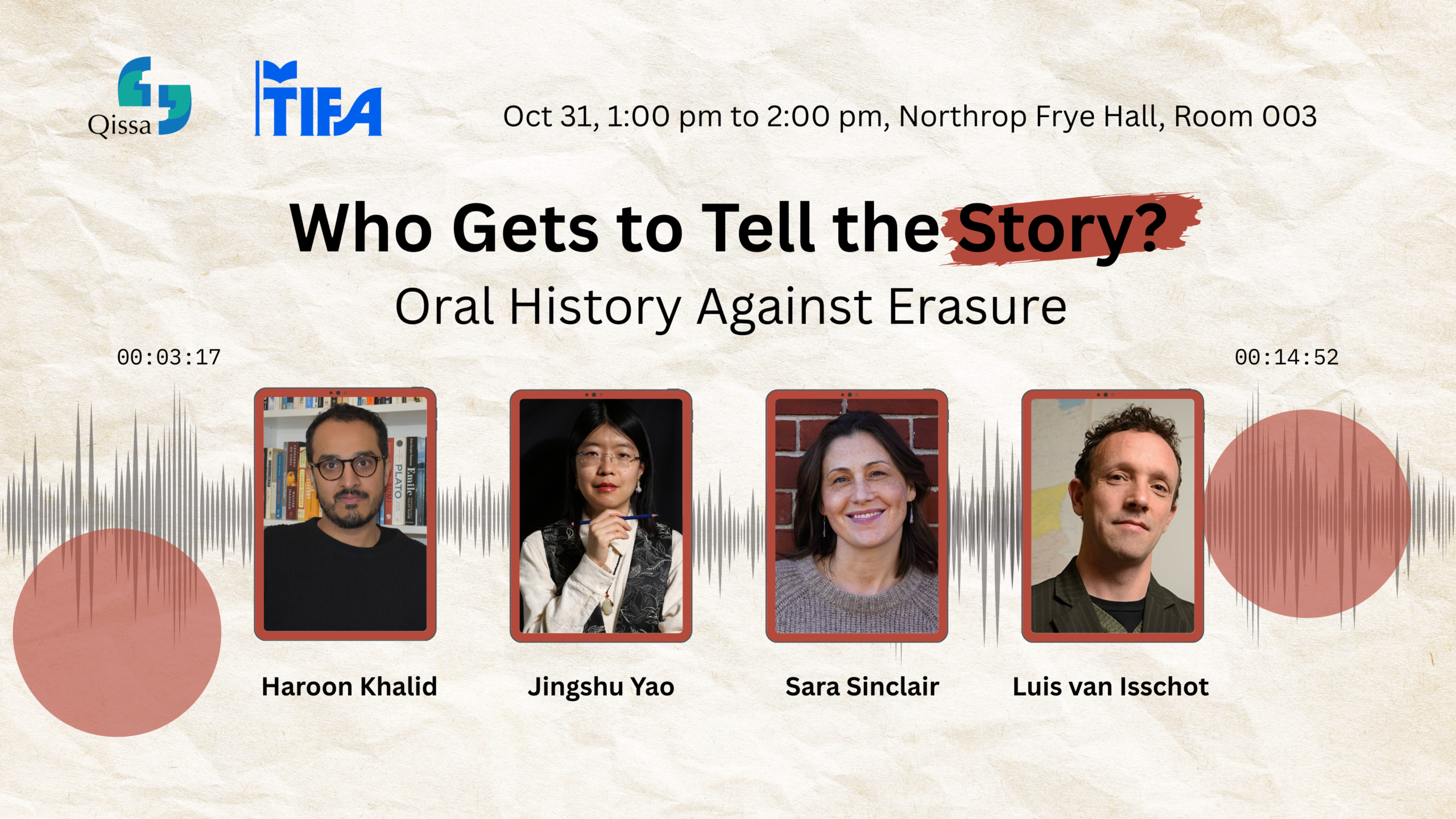
This session explores oral history as a way of challenging the stories that institutions, archives, and dominant cultures tell about communities. Bringing together Indigenous and immigrant approaches to oral storytelling, it asks who gets to decide what is remembered, whose knowledge is treated as history, and what gets lost when complex lives are reduced to familiar narratives.
Featuring:
Haroon Khalid: a writer, journalist, oral historian, and anthropologist whose work explores identity, history, religion, nationalism, and minority communities. He is the author of five books and more than 350 articles, and is the Co-Founder and Executive Director of Qissa, where he documents and shares oral histories of immigrants to Canada.
Sara Sinclair: a Toronto-raised Nehiyaw-Anishinaabe oral historian, writer, and educator whose work centres Indigenous voices and anti-colonial approaches to oral history. She has led major oral history projects at Columbia University and other cultural institutions, published five books, and worked with Murray Sinclair on his memoir Who We Are: Four Questions For a Life and a Nation.
Jingshu Yao: writer and community artist whose work explores food, immigration, language, queerness, and the intersectionality of identities. Their digital project North York Recipes for Healing documents East Asian recipe stories, and they are the recipient of the 2026 Toronto Arts Foundation Newcomer Artist Award.
Luis van Isschot (Moderator): an Associate Professor of History at the University of Toronto whose research focuses on political violence, human rights, justice, and memory in Latin America. His work spans oral history, human rights advocacy, and research with Colombia’s Truth and Reconciliation Commission, including interviews with Colombian exiles living in Canada.
Beyond Butter Chicken: Making the Immigrant Culture Palatable
Sun, Nov 1, 11:00 am to 12:00 pm
Northrop Frye Hall, Room 003
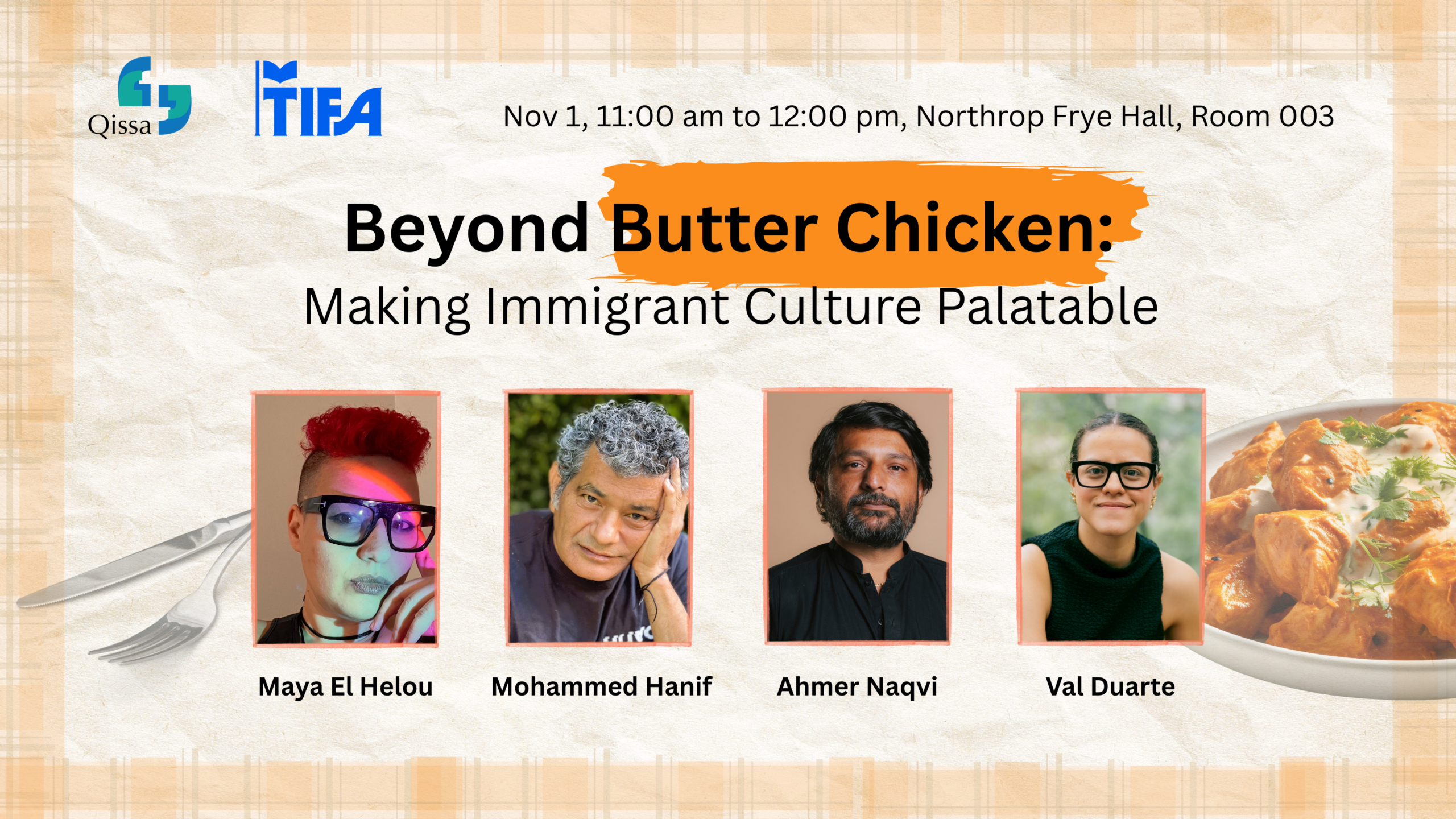
This session uses butter chicken—and food more broadly—as a lens for examining how immigrant identities are made palatable, marketable, and legible to dominant audiences. Moving beyond cuisine, the conversation explores the many ways immigrants learn to translate and repackage themselves: adjusting how they speak, describe their experiences, present their qualifications, and perform culture in order to be understood or accepted. It considers the line between adaptation and assimilation, and asks what is simplified, concealed, or lost when complex identities must be presented in familiar and consumable forms.
Featuring:
Maya El Helou: an anthropologist, lecturer, and published comic artist whose work explores violence, necropolitics, resistance, and survival through a queer feminist lens. Using graphic ethnography and visual storytelling, they critically engage settler colonialism, patriarchy, and intersecting systems of oppression.
Mohammed Hanif: a Pakistani novelist, journalist, playwright, and librettist whose work spans fiction, stage, radio, and journalism. His debut novel, A Case of Exploding Mangoes, won the Commonwealth Writers’ Prize for Best First Novel and was longlisted for the Man Booker Prize.
Ahmer Naqvi: a writer whose work uses popular culture to explore society, power, and everyday life, with a particular focus on food, cricket, and music. His writing has appeared in Fifty Two, Caravan, Dawn, and ESPNCricinfo, and he is the founder of Khanay Mei Kya Hai, a food tour initiative showcasing indigenous cuisines in Karachi.
Val Duarte (Moderator): is a researcher and strategist whose work sits at the intersection of writing, storytelling, and creativity. Her projects have explored creative labour, immigrant musicians, youth mentorship, and the future of work, with a focus on translating complex ideas, bringing different perspectives together, and imagining more human, creative, and sustainable ways of working.
Writing Between Jobs: Immigrant Writers, Precarious Work, and the Struggle to Create
Sun, Nov 1, 1 pm to 2:00 pm
Northrop Frye Hall, Room 003
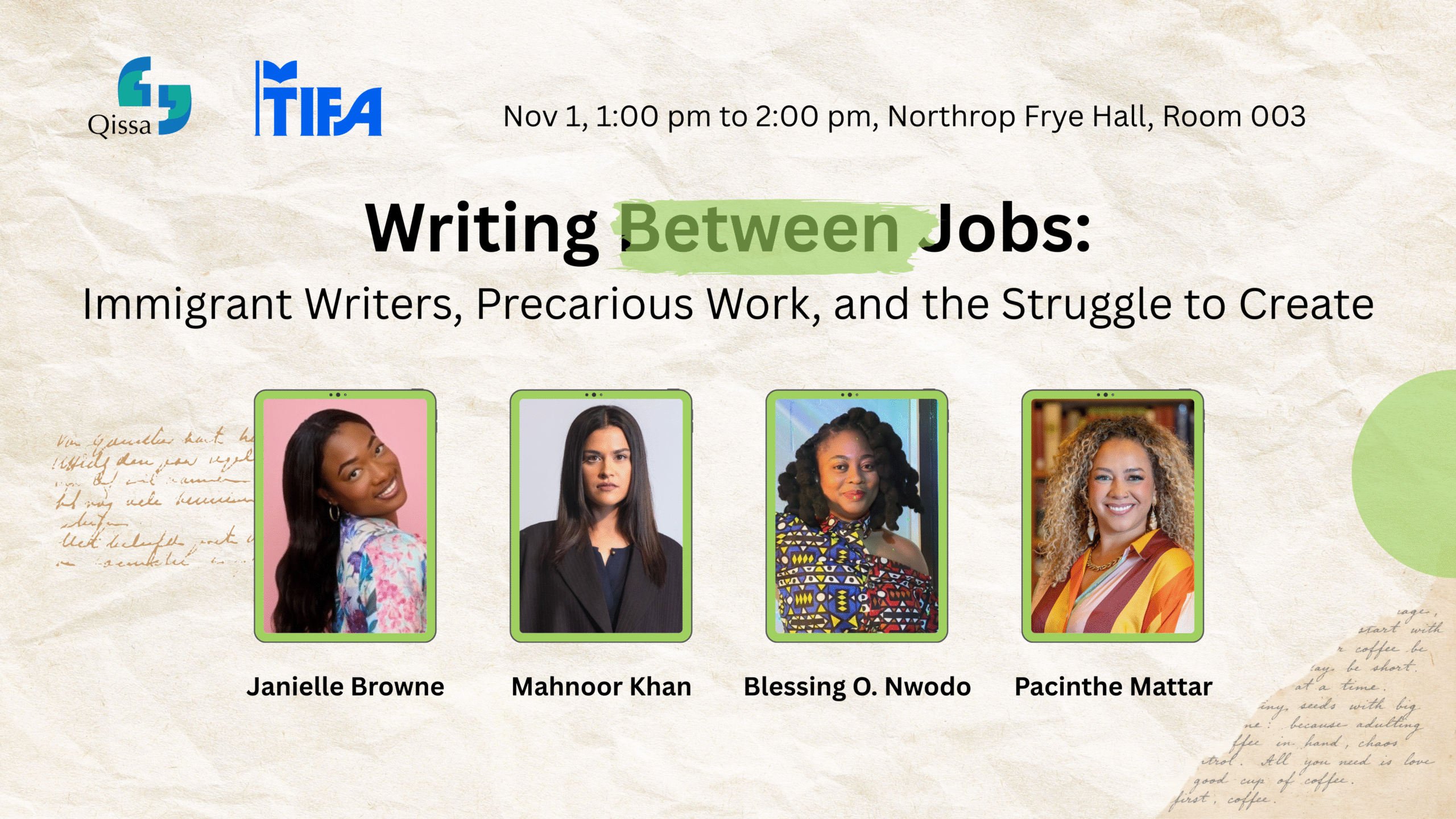
This session examines the hustle required to sustain a writing practice in an increasingly precarious economy, where artistic work itself is often underpaid, unstable, and dependent on short-term opportunities. For immigrant, newcomer, and refugee writers, these pressures are compounded by the demands of rebuilding a life in a new country, navigating the devaluation of previous experience and qualifications, and taking on other forms of work to survive. How do writers make a living? When do they write, what kinds of jobs do they take on, and what keeps them returning to the page despite financial pressure and uncertainty? The session also includes a theatrical performance based on Blessing O. Nwodo’s Time to Earn a Living that interrogates the absurdity of the phrase “earning a living,” questioning a system that demands proof of worth for the very act of being alive, and insisting instead on our inherent right not just to survive, but to live well.
Featuring:
Janielle Browne: a Vincentian writer and poet whose work explores injustice, gender, race, abuse, and diasporic identity. She holds an MA in Creative Writing from the University of Toronto and is a two-time recipient of The Jim Polk/Carol Shields Prize Foundation Scholarship in Creative Writing.
Mahnoor Khan: a Pakistani-Canadian actor and producer whose work spans theatre and film. She is also the co-founder of Virasat TO, a Toronto-based artist collective rooted in South Asian artistic practices and committed to representation, collaboration, and storytelling that reflects the complexity of lived experience.
Blessing O. Nwodo: a Toronto-based multidisciplinary storyteller whose work spans opera, immersive art, film, sonic storytelling, fiction, poetry, and nonfiction. A graduate of the Iowa Writers’ Workshop with an MFA from the University of Guelph, she is an award-winning writer whose work has been recognized by the Toyin Fálọlá Prize, African Writers Awards, and other literary honours.
Pacinthe Mattar (Moderator): a Toronto-based journalist, writer, producer, and journalism educator whose work examines race, power, and objectivity in journalism. A National Magazine Award–winning writer, she was a 2025–2026 William Southam Journalism Fellow at Massey College and has previously held fellowships at Harvard University and Western University.