Colonialism, Partition and Indigeneity: A Creative Dialogue Between South Asian and Indigenous Communities
Colonialism, Partition and Indigeneity brings together South Asian and Indigenous community members to explore the relationships between colonialism, borders, displacement, land, memory and belonging.
Partition as a symbol
Using the 1947 Partition of South Asia as both a historical reference point and a symbol, the project explores how borders, displacement and colonial systems continue to shape relationships to land, identity and belonging. Partition becomes a way of thinking about the power of colonial boundary-making: how lines drawn on maps can reorganize communities, produce new categories of belonging and exclusion, and leave consequences that extend across generations. For South Asian participants, this includes reflecting on Partition, migration, nationalism and inherited memories of colonial rule. For Indigenous participants, the conversation centres Indigenous sovereignty, relationships to land, and the continuing structures of settler colonialism in Canada.
Writing as a Space for Dialogue
At the heart of the project is a series of facilitated creative writing and storytelling workshops involving four South Asian and four Indigenous participants. Through conversation, writing and mentorship, participants will develop original pieces responding to questions of borders, displacement, otherization, language, land and the ways colonial histories continue to shape the present.
Rethinking Indigenous–Immigrant Relationships
The project also explores the need for a new framework to understand relationships between Indigenous peoples and racialized immigrant communities in Canada. Much of the historical conversation around immigrant/Indigenous relationship has centred on white European settlers. By bringing South Asian and Indigenous participants into dialogue, the project asks how these relationships might be understood differently—particularly when racialized immigrants themselves come from societies shaped by colonialism, partition, displacement and border-making.
Why Zion Schoolhouse?
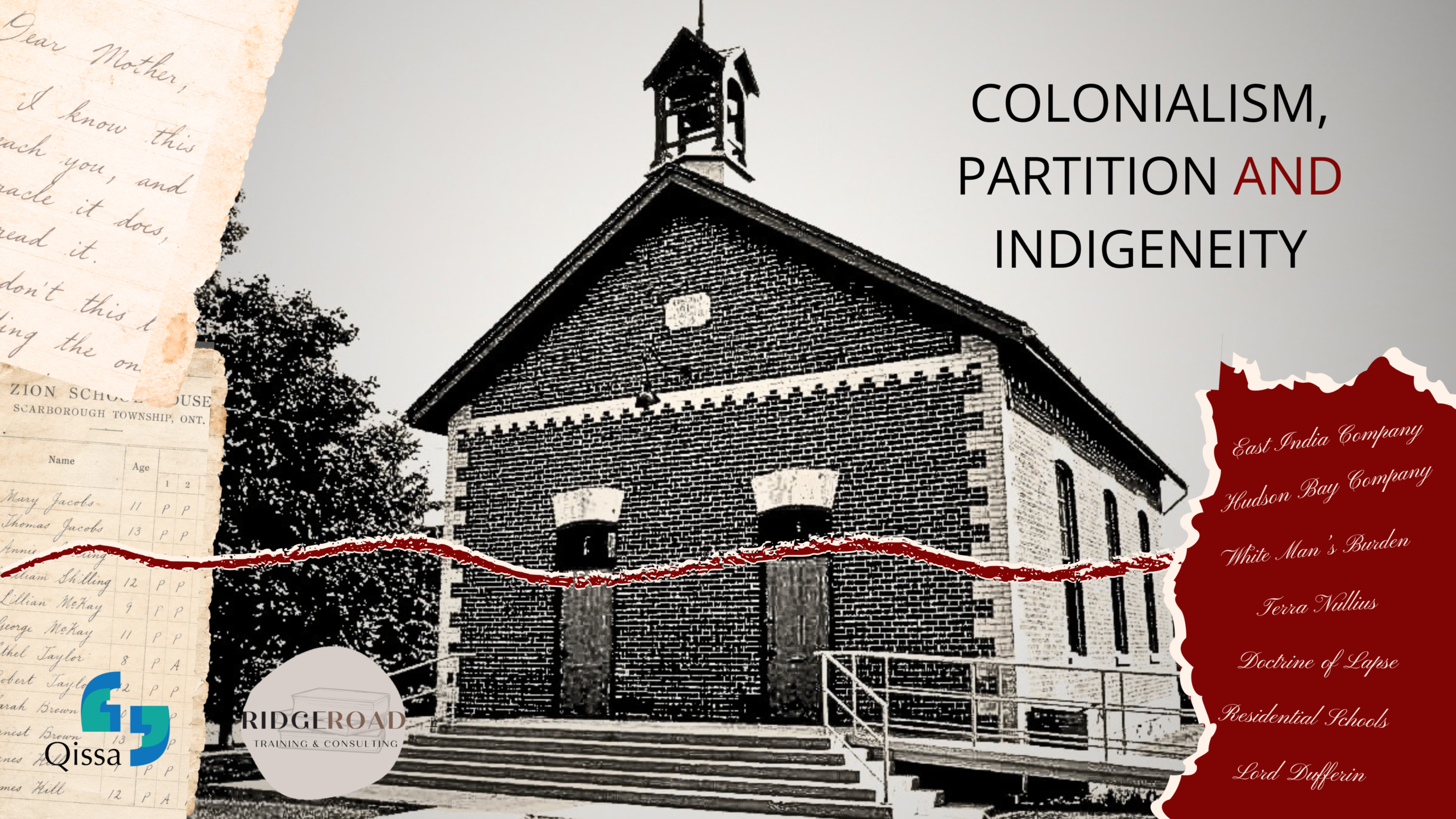
The participating community members will meet at Zion Schoolhouse, a historic Toronto History Museum site. The setting is intentional – education has played a central role in colonial projects, shaping how histories are taught, which languages and forms of knowledge are legitimized, and whose relationships to land and nation are recognized or erased. Meeting in a former schoolhouse creates space to examine how colonial ideas have been reproduced through education, while also asking how those histories might be taught, remembered and understood differently.
The project is being developed by Qissa in collaboration with Kiera Kaia’tano:ron Brant-Birioukov and RideRoad Training and Consulting.